GORE® Thermal Insulation for Semiconductor
High-cleanliness insulation delivers up to 35%* more energy efficiency in on-tool gas lines, enabling heating jackets with superior thermal performance and less bulk.
Achieve Up to 35% Energy Savings in Semiconductor Manufacturing
Semiconductor manufacturing demands cost control, cleanliness and consistent quality. But typical fiberglass and aerogel insulation in heating jackets can create issues: particle shedding and installation complexity; concerns about temperature stability and long-term cleanroom compatibility. GORE Thermal Insulation delivers efficient, cleanroom-compatible performance without the complexity.
Save energy. Save space. Minimize contamination risk.
GORE Thermal Insulation can enable up to 35% energy savings, with less bulk and higher cleanliness than traditional or aerogel insulations. Ideal for on-tool gas lines in cleanroom environments.
How Does Gore’s Insulation Material Outperform Fiberglass and Aerogel Insulation for On-Tool Gas Delivery Lines?
GORE Thermal Insulation was engineered around a simple concept: Superior thermal performance for greater energy savings, without the disadvantages of fiberglass bulk, or aerogel particulation.

Optimize Energy Savings & Efficiency
Improve thermal performance vs. current insulation material. GORE Thermal Insulation helps to minimize heat loss, for up to 35% energy savings. Reducing energy consumption can add value to sustainability initiatives, too!

Improve Thermal Stability
Uniform thickness, high conformability and low conductivity (0.018 W/mK) enable precise and stable temperature control, with less drift at joints and bends. It can help optimize sensitive chemical reactions, avoid condensation, and ensure consistent product quality and process efficiency at temps up to 280 °C.

Reduce Bulk to Simplify Integration
Thin/less bulky thermal insulation enables more compact heating jackets, which can free up more space within tightly-configured on-tool environments. It also enables easier heating jacket installation and removal for maintenance.

Minimize Contamination Risk for Superior Cleanroom Compatibility
Ultra-low particulation minimizes the chance of releasing contaminants during cleanroom installation or maintenance. Easier to handle and integrate into heating jackets — no PPE required.
How Does Heating Jacket Insulation Boost Energy Savings for On-Tool Gas Delivery Lines?
Until now, reducing gas line heat loss meant adding more insulation to the heating jackets, resulting in excess bulk, or added risk of particulation...or both.
GORE Thermal Insulation for Semiconductor offers a offers a higher-performance alternative to both aerogel mats and conventional insulation layers like fiberglass, nylon felt or polyimide.
Reduced Energy Waste and Operating Costs = Improved Process Stability and Higher Yields
Gore’s Superior Thermal Performance Reduces Energy Consumption: Save Up to 35% vs Other Pipe Wrap Insulation
Reducing energy consumption and the amount of “wasted heat” is great for lowering operating costs, and can be a solid contributor to sustainability goals and “net zero” initiatives.
Heating jackets that incorporate GORE Thermal Insulation can:

Achieve energy savings of up to 35% by reducing heat-transfer loss, more consistently, along the length of the line.

Help to maintain better process temperature stability within on-tool gas delivery lines, even at continuous operating temperatures up to 280° C.

Heating Jackets with Other Insulation Materials
- Higher, inconsistent conductivity
- Variations in process temperatures along the length of the gas line
- Notable heat loss at bends or fittings

Heating Jackets with GORE Thermal Insulation
- Ultra-low, very uniform conductivity to minimize heat loss
- Precise, stable process temperature control all along the gas line
- Continuous operating temps to 280 °C.
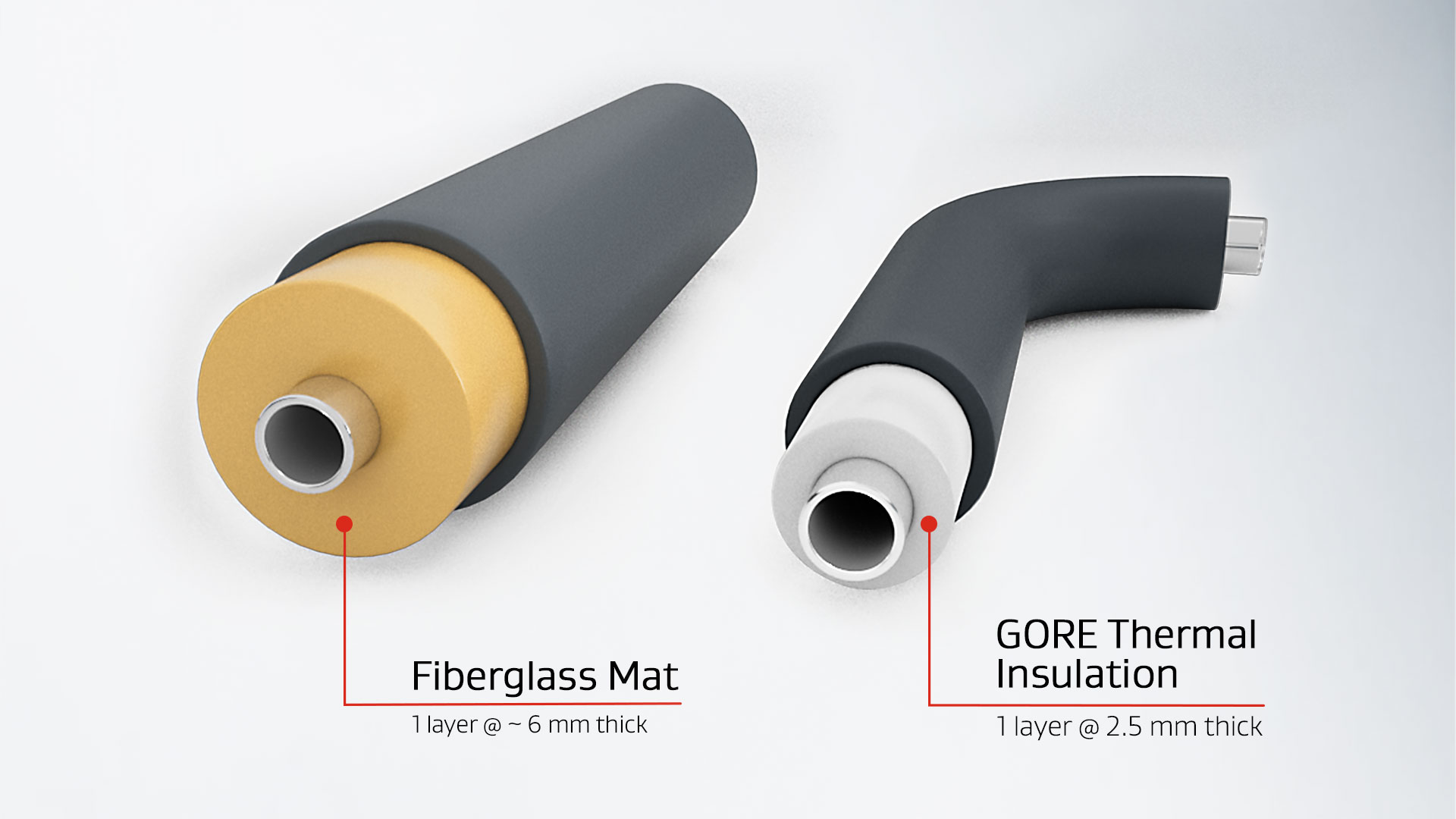
Save space. Make room for future growth.
With GORE Thermal Insulation you can achieve the same thermal performance with less bulk, so you can reclaim space: Make room to add more gas lines within the box, or simplify maintenance on tightly-spaced delivery and exhaust lines.
Better Heat-Insulating Performance with Less Bulk
GORE Thermal Insulation vs. Fiberglass Mats
| Fiberglass Mat | GORE Thermal Insulation | |
|---|---|---|
Energy Savings | 0% Baseline | Up to 35% |
Particulates PPE required for Jacket Production? | High Yes | Low No |
Bulk* | Thick > 2x | Thin < ½x |
* For equivalent thermal performance/equivalent touch temp.
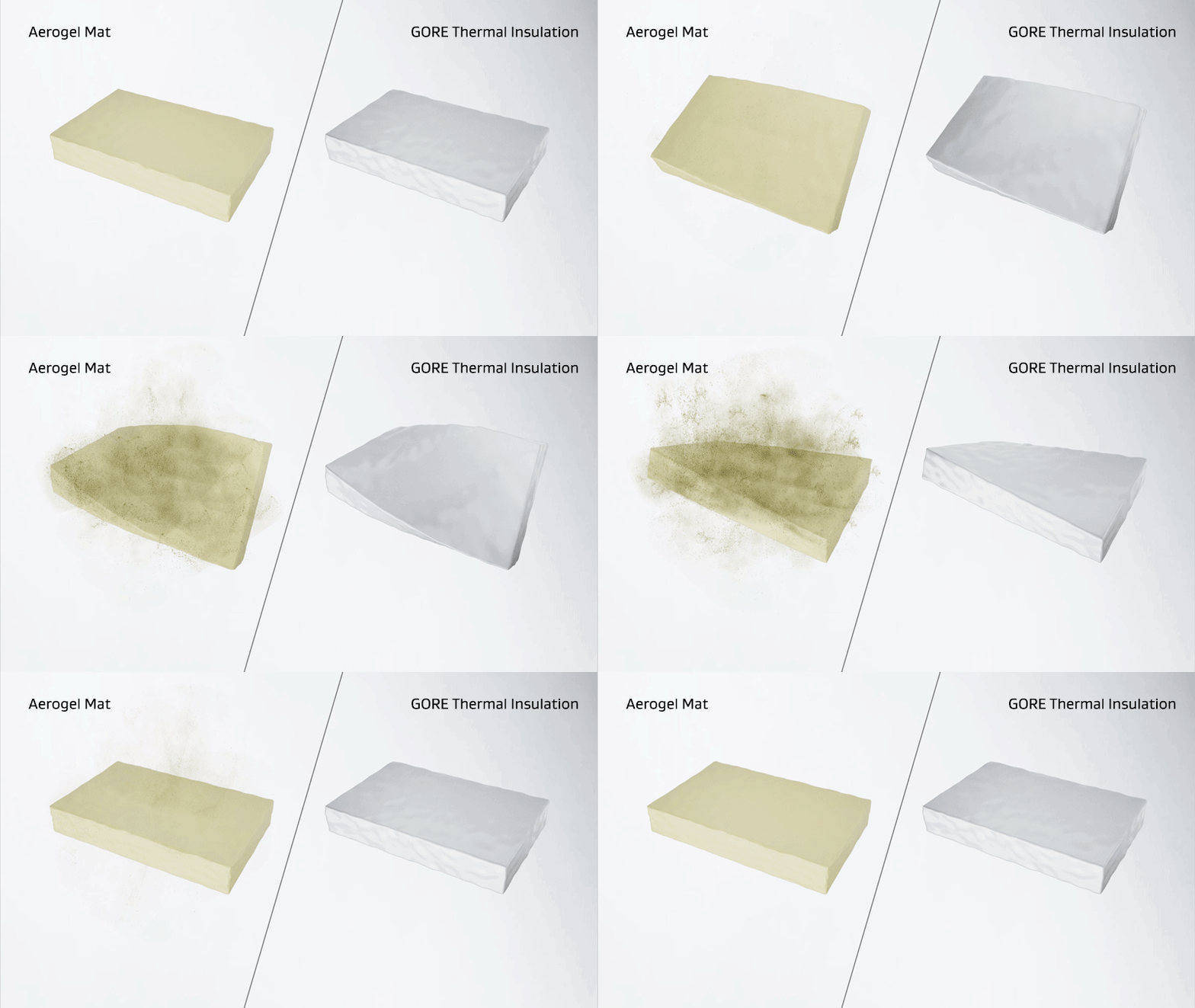
Greater Confidence Within the Cleanroom
Unlike aerogel mats, which can readily shed particulates during in-cleanroom maintenance, the aerogel in GORE Thermal Insulation is fully encapsulated within the composite structure.
Higher Energy-Efficiency and Higher Cleanliness
GORE Thermal Insulation vs. Aerogel Mats
| Aerogel Mat | GORE Thermal Insulation | |
|---|---|---|
Energy Savings | 0% Baseline | > 9%* |
Particle Shedding Risk Level | High | Low |
Conductivity Uniformity | Higher Variable | Lower Consistent |
* Data available upon request.
Consistently lower conductivity. Higher cleanroom confidence.
Cross-section:
Aerogel Mat Insulation
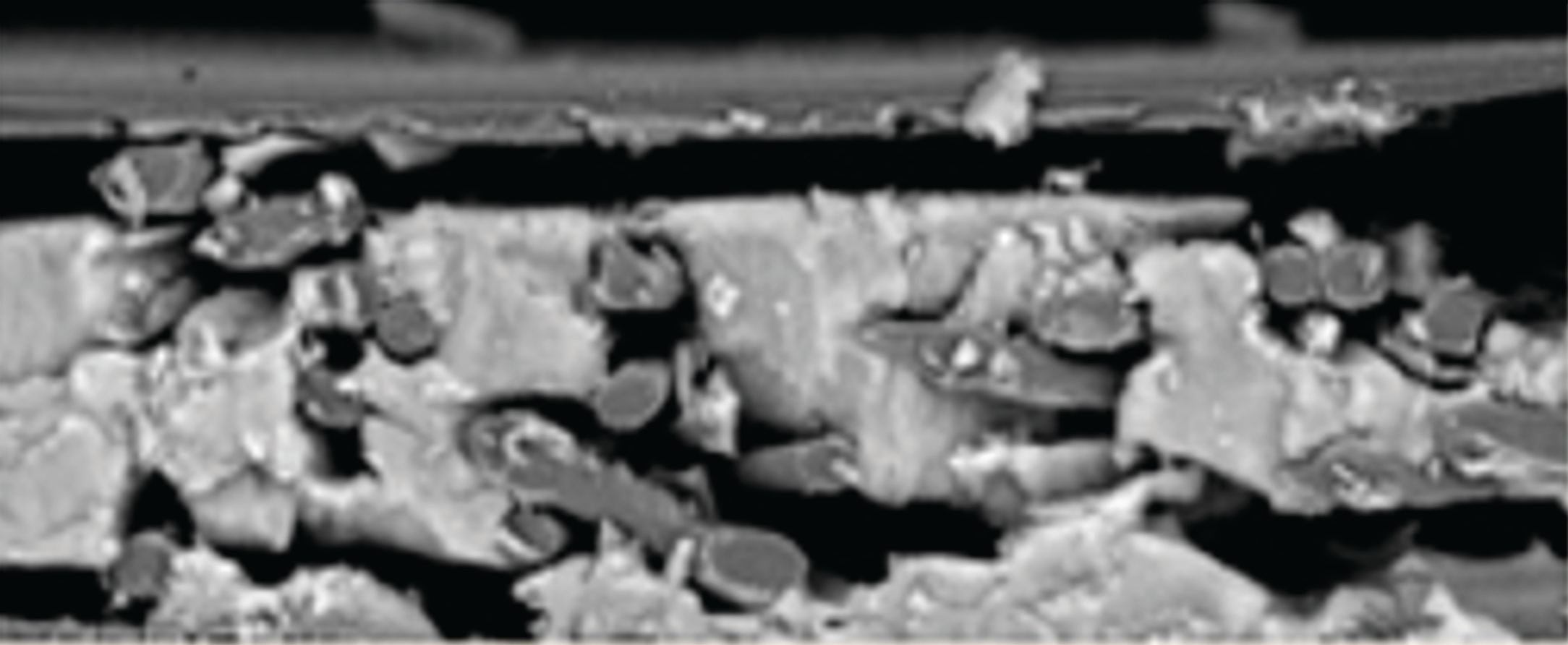
- Higher conductivity
- Variable structure
- Variable conductivity
- Shedding particles
Cross-section:
GORE Thermal Insulation
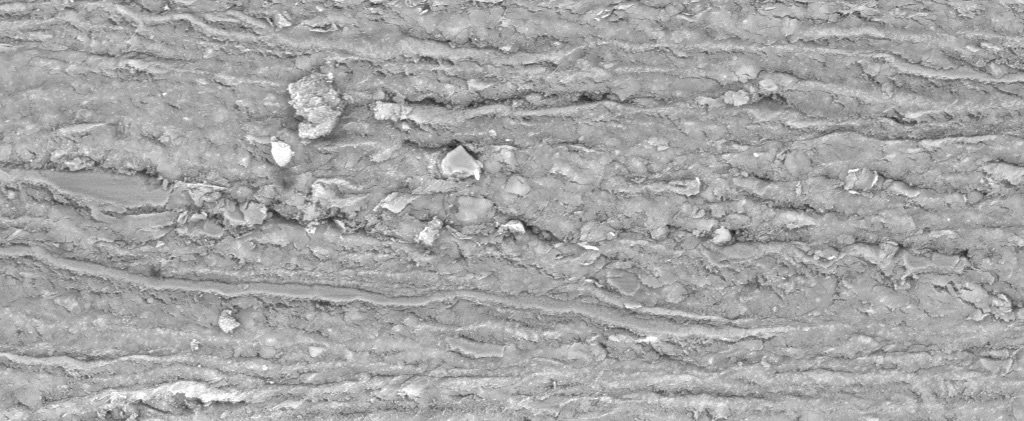
- High loading of aerogel to obtain low conductivity
- Uniform distribution of aerogel to enable consistent conductivity
- Uniform thickness
- High cleanliness

Technical Specifications
| Insulation thickness (mm) | 2.5 |
|---|---|
| Thermal conductivity (k)a | 0.018 W/mK |
| Thermal Resistance | > 0.125 m2K/W |
| Compression @100 kPA (14.5 psi) | 5% |
| Specific heat capacityb | 1.8 J/g °C |
| Bulk Density | 0.27 g/cc |
| Operating Temperature | -40 °C to 280 °C |
| Flammability | UL 94 V-0 |
| Outgassing @ 250 °Cc | < 1% TML < .1% CVCM |
| How supplied | Roll goods |
| RoHSd | Meets threshold requirements |
a Nominal conductivity value based on a modified version of ASTM C518.
b Nominal heat capacity measured according to ASTM E2716 Method B at 75 °C.
c Outgassing per ASTM E595.
d To the best of our knowledge, the product listed above does not have any restricted substances above the maximum concentration values listed in RoHS Directive 2011/65/ EU and meets the substance restrictions of Article 4 of RoHS Recast including Commission Delegated Directive 2015/863.
We commit to every customer that “our products will do what we say they will do" — and we stand behind that promise with our worldwide resources, expertise, and quality processes.
Gore monitors and strives to comply with all regulations applicable to our products.
We have worked with our suppliers to eliminate PFOA from our supply chain. Our products meet EU REACH regulations EU 1907/2006 and EU 2019/2021.
Frequently Asked Questions
A. As more tools and fabs are running “hotter” processes, it’s important to have insulation that’s designed for higher process temperatures. GORE Thermal Insulation was engineered specifically to withstand continuous operating temperatures of up to 280 °C without becoming embrittled, or suffering a loss in its thermal performance. And it can deliver energy savings of up to 35% in the process!
A. Thin, conformable GORE Thermal Insulation can make that possibility a reality. Just one layer of 2.5 mm GORE Thermal Insulation enables the same touch temperature as ~ 6 mm of fiberglass. So ... all the insulating power, with less than half the thickness. Ideal for those ¼ inch forelines.
A. Condensation forms due to temperature differentials within the line; specifically, when the heated gas passes through a cooler area of the line. Maintaining precise temperature control is essential to prevent condensation from forming. The superior thermal performance of GORE Thermal Insulation derives from its ultra-low conductivity and ultra-uniform material. Both enable improved temperature stability over the length of the line, including at bends and fittings, where traditional insulating materials tend to “leak” heat.
A. One way is to consider what insulating materials are in the heating jackets you’re installing or removing. If aerogel is included, be aware there’s a higher risk that it could contaminate the cleanroom. That’s because, in bending the heating jacket to install or remove it from the pipeline, you could cause aerosolized particles to “puff out” of the jacket through the needle-holes in the stitched seams. GORE Thermal Insulation can help to minimize that risk, because our aerogel is fully encapsulated within the composite structure.
A. One option is to “spec in” the superior thermal performance of GORE Thermal Insulation in heating jackets for all your forelines, on-tool gas delivery and exhaust lines. Field tests demonstrate Gore’s insulation delivers up to 35% more energy savings than fiberglass, and > 9% more energy savings than aerogel mats. Reducing “waste heat” and energy consumption contribute to sustainability. And, because GORE Thermal Insulation enables more precise temperature control and better temperature stability, yields may increase.

Explore More



* Data available upon request.
FOR INDUSTRIAL USE ONLY
Not for use in food, drug, cosmetic or medical device manufacturing, processing, or packaging operations.
Prefer to Call?
Have questions or unique requirements?
Our experts are here to guide you.