GORE Battery Insulation
Our ultra-thin, mechanically durable insulation maintains reliable, consistent thermal runaway protection under demanding conditions throughout the battery’s lifetime.
Reliable & Consistent Thermal Runaway Propagation Protection
GORE Battery Insulation helps protect your battery installation from thermal runaway propagation while enabling higher energy density. Our low-compressibility, low-thickness material maintains its thermal resistance even under high pressure and temperatures. Engineered for easy processing, it also supports clean, efficient battery module manufacturing.
Battery Module Thermal Insulation Engineered for Lifetime Performance
In higher energy density designs, traditional insulation materials — like aerogel pads and silicone foams — tend to lose thermal resistance under sustained load and may experience performance degradation and dimensional creep at elevated kPa levels. These issues force battery module designers to add thickness or safety margin to maintain propagation protection.
Built with an innovative material, GORE Battery Insulation breaks the compression-thermal barrier tradeoff with many features and benefits over traditional thermal barriers.
- Mechanically stable, low compressibility insulation maintains high thermal resistance under pressure at >1000 kPa with <0.5% compressive set.
- Ultra-low thermal conductivity of <50 mW/m-K, even at 500ᶱC, to limit heat transfer in high energy density designs.
- Non-particulating, flexible, cuttable and bondable material supports efficient, low-contamination manufacturing.
- Advanced insulation technology is designed to maintain thermal barrier integrity throughout the module’s lifetime — from commissioning and installation through operation and to the end of module life.
- Ultra-thin (1 mm), non-fluorinated composite supports compact pack designs without adding thickness or propagation safety margin.
- Hybrid stack compatible format integrates easily with compliant pads to accommodate cell swelling without compromising thermal protection.
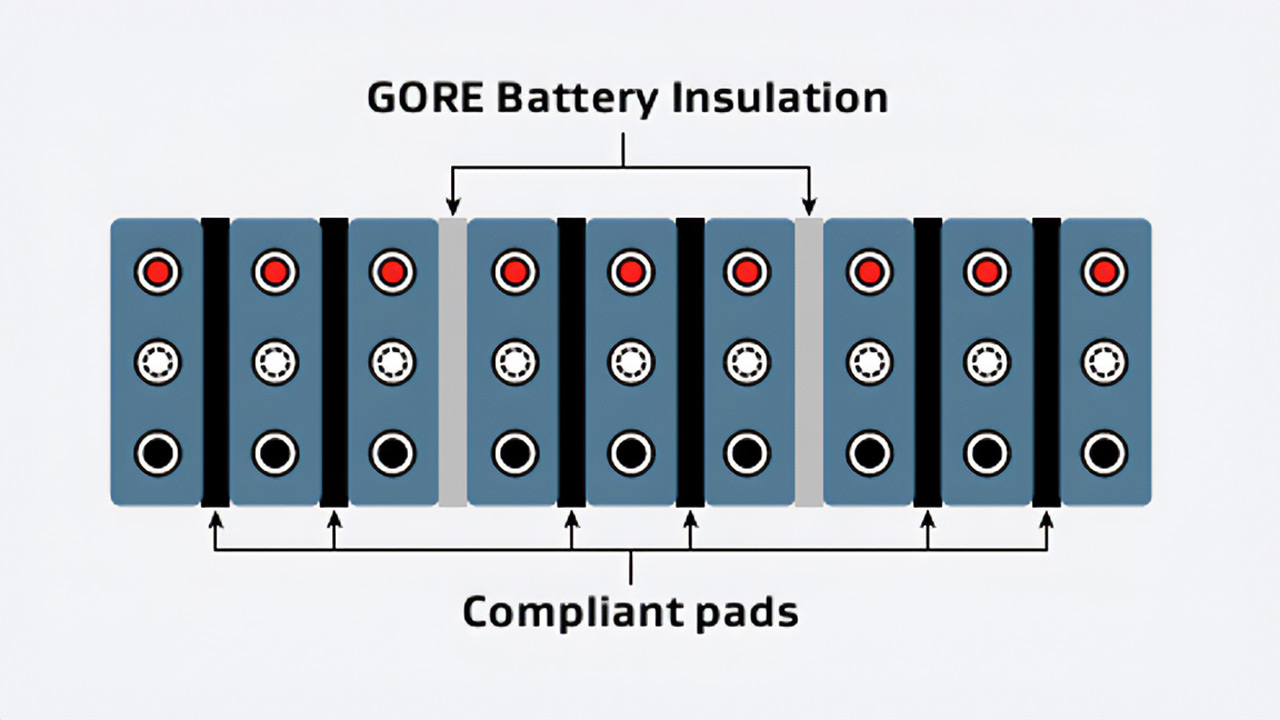
Designed for Preventing Thermal Runaway Propagation in High Energy Density Applications
GORE Battery Insulation is designed for any battery module requiring thermal runaway protection and is compatible with multiple battery chemistries. Our ultra-thin battery insulation is best suited for pouch and prismatic cell formats, but can also be used in cylindrical applications.
- Battery energy storage systems (BESS)
– Utility (grid), residential, commercial and industrial - Electric vehicles (EV)
- Outdoor power equipment (OPE)
- Larger industrial equipment (IEM)
- Data centers
- Marine & locomotive equipment
- and more…



In high-density energy battery packs, intercell material is held under sustained mechanical preload. As thermal barriers are further compressed over time, a reduction in thickness becomes inevitable, increasing the risk of heat propagation between cells. Maintaining insulation durability and thickness under load is critical to long-term thermal protection.
How Do Thermal Barriers Stack Up?
Compare GORE Battery Insulation against conventional thermal barriers to better understand their critical attributes and overall performance in high-density cell architectures.
| Critical Attributes | Foam Pads | Rigid Inorganic Layers (mica) | Aerogel Pads | GORE Battery Insulation |
|---|---|---|---|---|
Ambient (T/P) Thermal Conductivity | ❌ | ❌ | ✔️ | ⚠️ |
Thermal Resistance under Compression | ❌ | ⚠️ | ❌ | ✔️ |
Mechanical Stability Over Life | ❌ | ✔️ | ❌ | ✔️ |
High-Temperature Stability | ❌ | ✔️ | ✔️ | ✔️ |
Durability under Cycling & Swelling | ✔️ | ⚠️ | ❌ | ✔️ |
Clean Handling | ✔️ | ❌ | ❌ | ✔️ |
Ease of Integration | ✔️ | ❌ | ⚠️ | ✔️ |
Energy Density Impact | ❌ | ❌ | ⚠️ | ✔️ |
✔️ = Acceptable/Good
⚠️ = Concern/Uncertainty
❌ = Unacceptable/Low Performance
Real-World Comparison Test
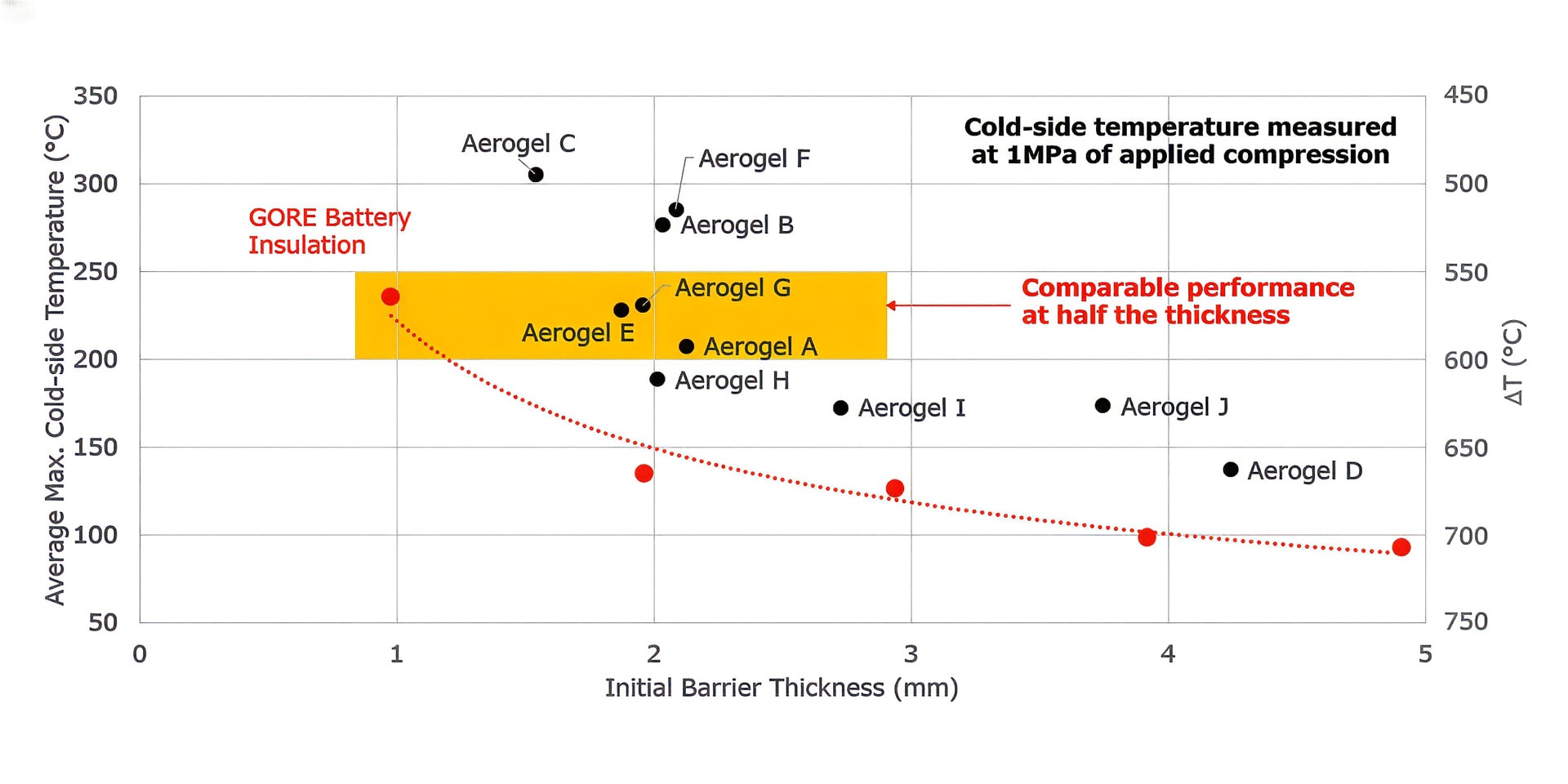
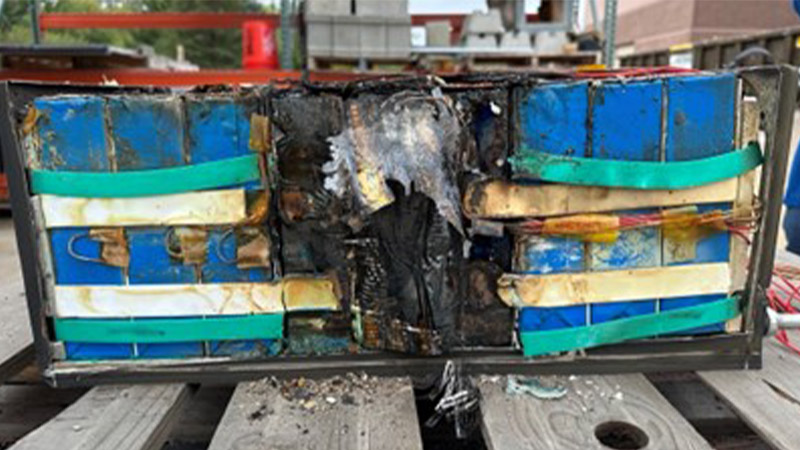
In a simulated thermal runaway test, insulation materials and cells were put under realistic compression at 1 MPa. Results showed that GORE Battery Insulation outperformed competitive aerogel materials at all thicknesses and provided equal thermal protection at half the thickness of typical aerogel insulation products.

Listen to Gore experts explain how our insulation can help improve the safety of battery storage installation and protect against thermal runaway propagation.
Watch this free on-demand educational webinar for an in-depth look at Gore’s innovative battery insulation technology with real-world case studies and listen to Q&As.
Technical Information
GORE Battery Insulation maintains dimensional and thermal stability under sustained stack pressure in high density energy applications.
| Vent Criteria | Target Value |
|---|---|
Nominal Material Thickness¹ mm | 1 |
Dimensional Tolerances % | ± 10 |
Compression Strain at 1 MPa Stress % | < 5 |
Density g/cc | 0.4 |
Thermal Conductivity at 600°C mW/m-K | < 50 |
Average Dielectric Strength V/mm | 25,740 |
Flammability Rating | UL94 HB |
Material Structure | Non-Fluorinated Composite |
1 Exact material thickness subject to change.

Featured Content






Frequently Asked Questions
Gore's insulation is relatively incompressible compared to conventional thermal barriers, like aerogel, silicone, foam and cork. It means that our insulation maintains its thickness and thermal resistance even under high compression stress, which is common in battery module production and during thermal runaway events.
We can also deploy our insulation in thinner layers, enabling increased energy density at the module level. Our insulation is also non-particulating, cuttable and bondable, making it easier to handle during manufacturing.
Compression reduces insulation thickness, which directly reduces thermal resistance (R-value). Traditional, compressible materials, like an aerogel composite or a silicone foam pad, require additional thickness or a safety margin to maintain propagation protection.
But the compression-stable structure of GORE Battery Insulation ensures consistent thermal resistance even under typical end-of-life pressures of 1000 kPa found in BESS and EV systems.
Unlike conventional thermal runaway barrier materials, Gore's insulation resists deformation and maintains high thermal resistance under high compressive stress.
For battery modules that require compliant interface materials to accommodate cell swelling, our insulation can be strategically paired with engineered compression pads — separating the jobs of thermal propagation control and swelling accommodation for optimal performance.
Yes, Gore's insulation can be used as a drop-in replacement in battery systems. Our insulation also avoids dusting, mechanical fragility and compression loss — all common limitations of alternative thermal runaway barriers, like aerogel battery insulation.
Gore is testing its insulation to meet key industry standards, including UL94 HB flame resistance and other relevant certifications for battery safety and reliability. Our non-fluorinated insulation also aligns with EU REACH and EPA PFAS restrictions.

Explore More



FOR INDUSTRIAL USE ONLY
Not for use in food, drug, cosmetic or medical device manufacturing, processing, or packaging operations.
Prefer to Call?
Have questions or unique requirements?
Our experts are here to guide you.