Break the Compression-Thermal
Barrier Tradeoff
Ultra-Thin, Mechanically Durable Insulation for High-Density Cell Architectures
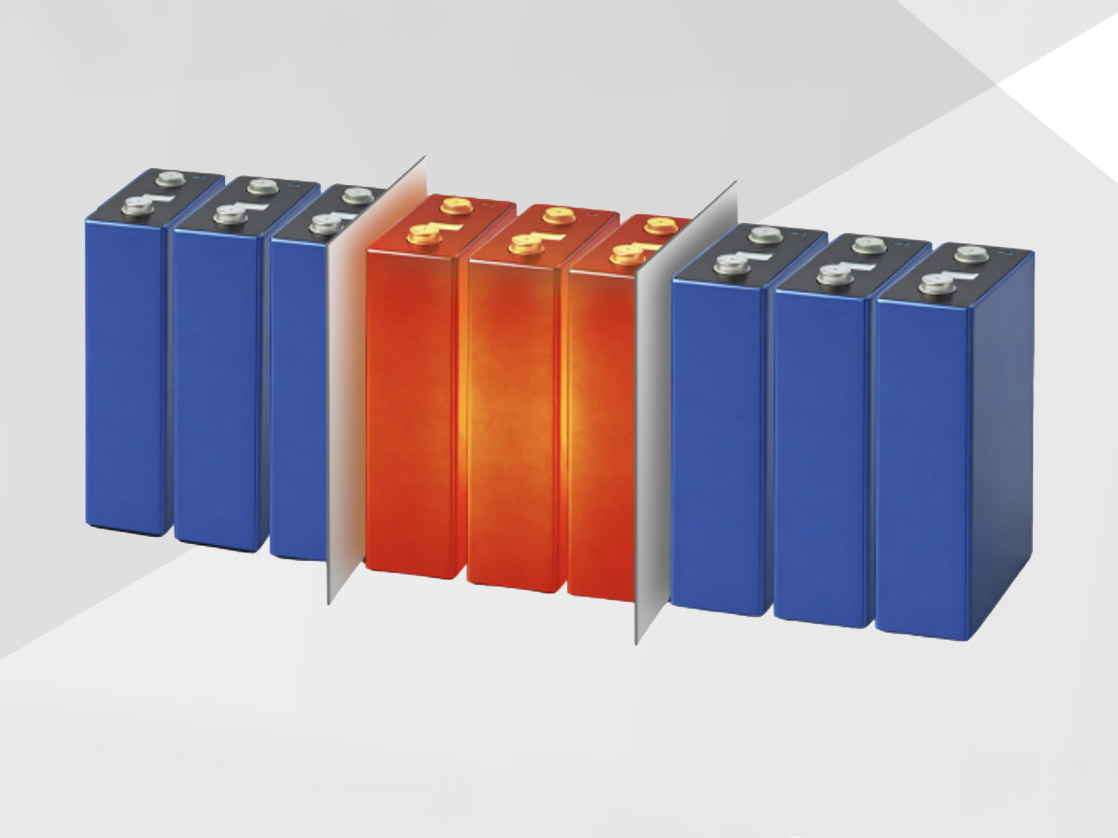
Thermal Barriers That Maintain Performance Under Stack Pressure
As prismatic cell formats move toward higher compression to increase energy density, many conventional intercell insulation materials lose thermal resistance under sustained load.
Materials such as aerogel composites and silicone foams can experience measurable performance degradation and dimensional creep at elevated kPa levels. This forces pack designers to add thickness or safety margin to maintain propagation protection.
Compression-Stable Thermal Protection for High-Density Designs
GORE Battery Insulation (GBI) maintains high thermal resistance at >1000 kPa, with <0.5% compressive set. At low thickness, GORE Battery Insulation enables consistent intercell barrier performance without sacrificing stack pressure, volumetric density or long-term stability. Engineered for easy processing, GORE Battery Insulation supports clean, efficient battery module manufacturing.
Performance that Lasts the Battery Lifetime
GORE Battery Insulation is designed to maintain dimensional and thermal stability under sustained stack pressure in high-density cell architectures.
- <0.5% compressive set under load
- <50 mW/m·K thermal conductivity
- <1 mm thickness for space-efficient integration
- Non-shedding, flexible, die-cuttable and bondable
By maintaining barrier integrity throughout installation and operation, GORE Battery Insulation supports compact pack designs without requiring added thickness or propagation safety margin.
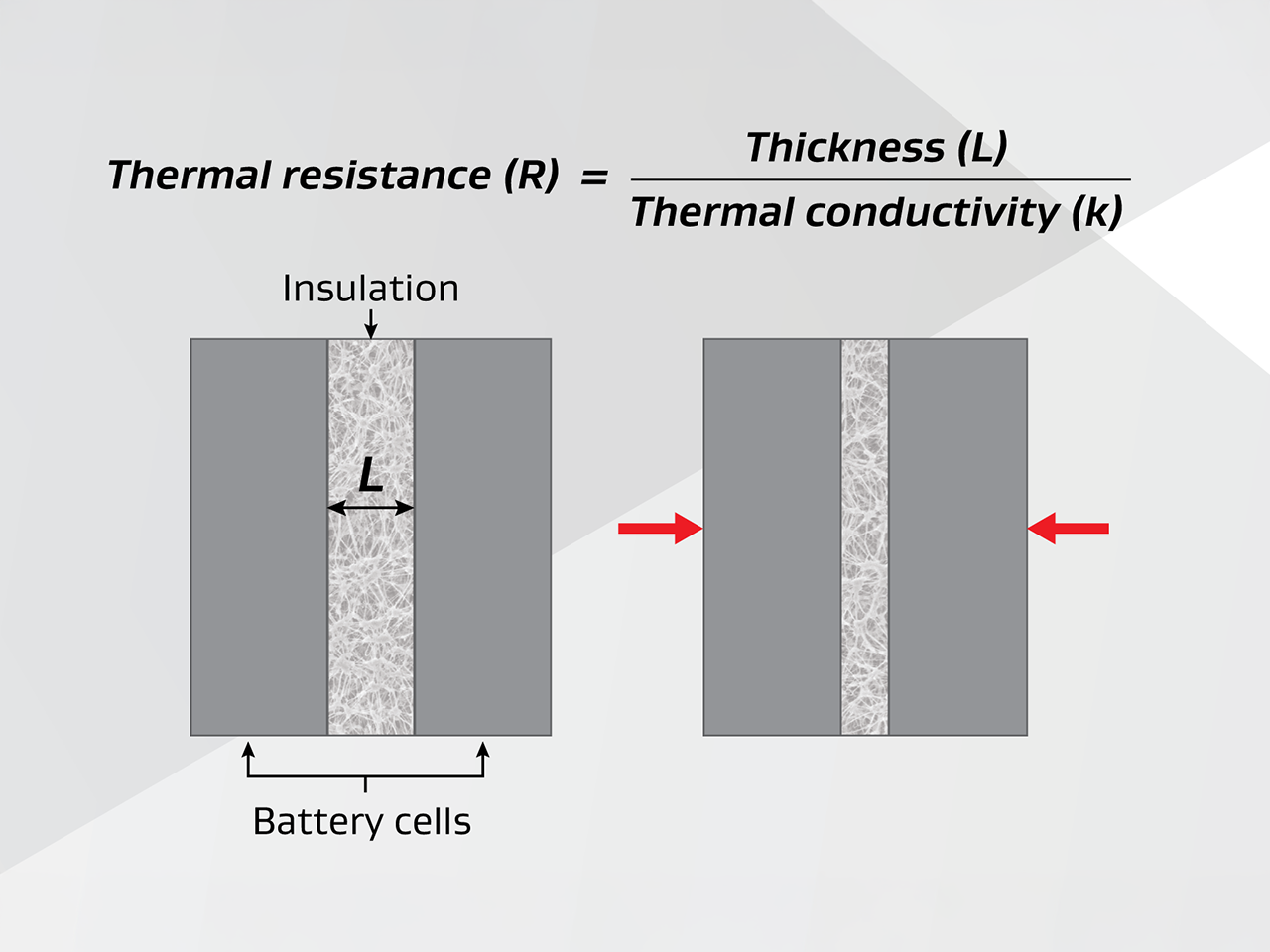
How Does It Stack Up Against Other Thermal Barriers?
In high-density energy battery packs, intercell material is under sustained mechanical load. As thermal barriers are compressed over time, if thickness is reduced, the risk of heat spreading between cells increases. Maintaining insulation durability and thickness under load is critical to long-term thermal protection.
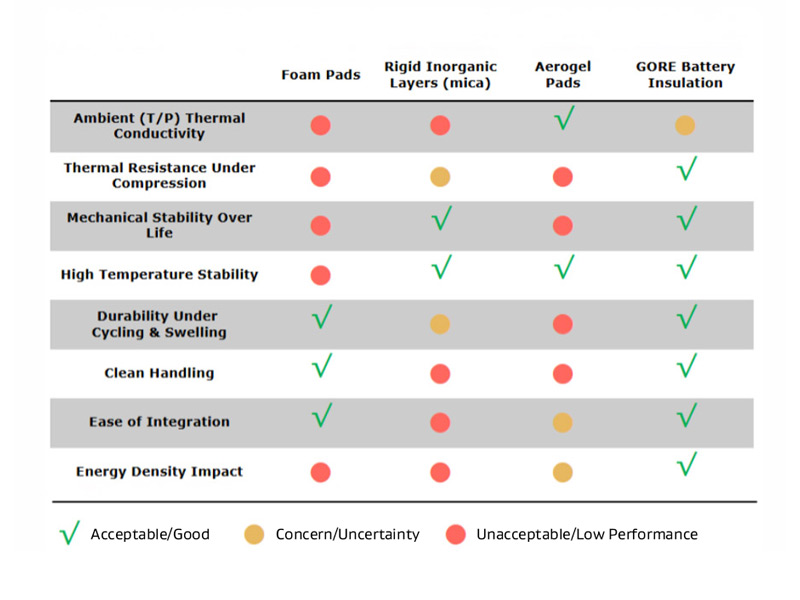
Pack-Level Thermal Protection
GORE Battery Insulation helps sustain pack-level thermal performance and mechanical integrity under sustained compression and cycling.
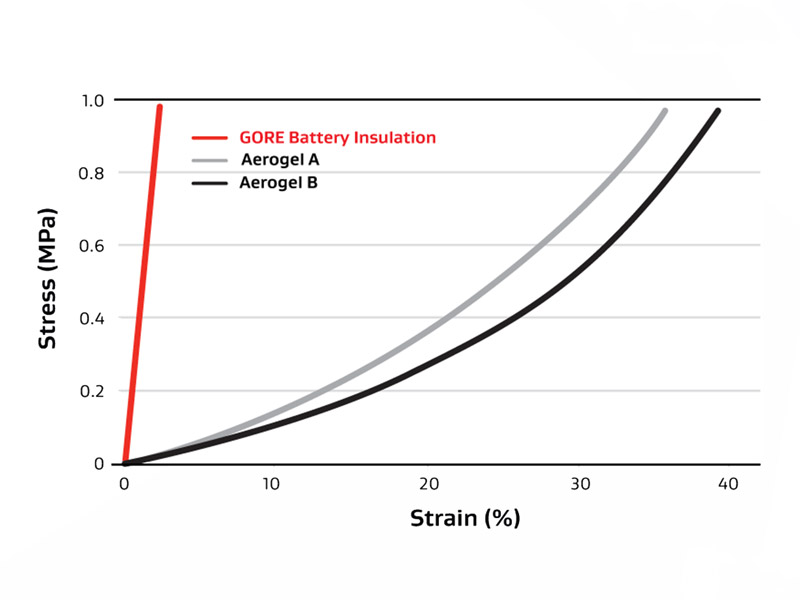
Compressibility Under Load
Compared to aerogels, GORE Battery Insulation exhibits low strain at high pressures.
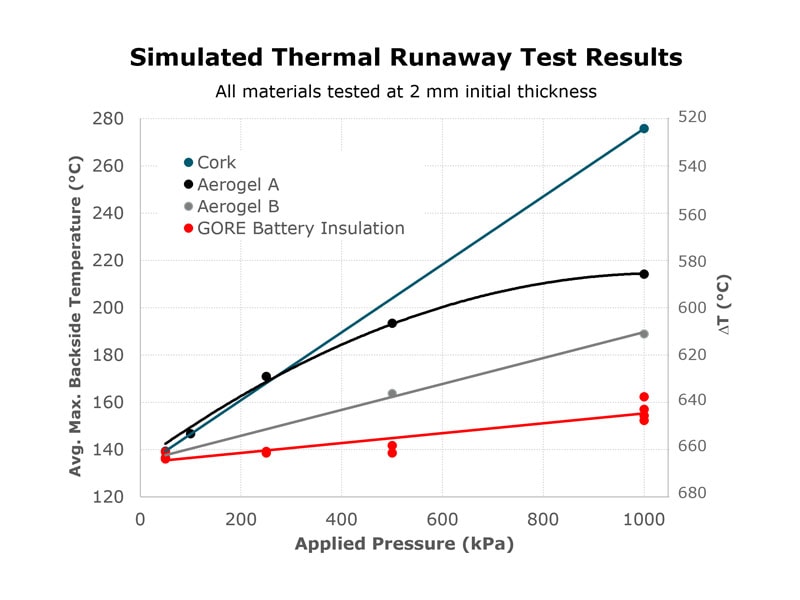
Real-World Test
In a simulated thermal runaway test, GORE Battery Insulation showed a controlled, stable temperature response across increasing pressure.
Working on a New Battery Design?
Request a sample and validate performance in your application.