Venting

Oleophobic Membranes


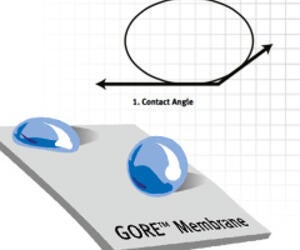
The key to choosing the appropriate membrane technology for a given application is understanding the environmental conditions and the surface tension of the fluids that the vent will encounter. The surface tension of a fluid has a direct impact on the ability of a membrane to repel the fluid's entry into a component. In high surface tension fluids like water, there is a large differential in the surface free energy of the membrane and the surface tension of the liquid. When a significant differential exists, the contact angle between the solid surface and the liquid is higher. The greater the contact angle, the more likely the liquid droplets will be repelled and not wet-out the membrane. Low surface tension fluids like oil are more difficult to repel, as the differential in membrane surface free energy and the liquid surface tension is lower. However, recent oleophobic membrane technology has tackled this problem and provided a solution.

Hydrophobic Membranes: Unmatched Performance Against High Surface Tension Fluids Like Water

Hydrophobic membranes have been used successfully in hundreds of millions of vents worldwide, proving to be a reliable, rugged and cost-effective solution in many demanding markets. This technology provides effective pressure equalization for components that experience wide temperature variations and possible exposure to water. Hydrophobic membrane vents allow components to breathe, reducing the pressure within the unit while preventing the ingestion of water.

Ideal applications for hydrophobic membrane vents are those products that are exposed to water, including various medical devices and some electronic devices such as battery vents. Using vents made with hydrophobic membranes allows components to maintain a stable internal pressure while preventing water from contaminating the internal structure.

Realize the Benefits of Venting Technology From Gore:

  • Optimal airflow
  • Pressure equalization
  • Protection against high surface tension fluids such as water
  • Protection against low surface tension fluids such as oil - an additional benefit unique to the oleophobic membrane

Oleophobic Membranes: Unmatched Performance Against Both High and Low Surface Tension Fluids Like Oil

Because low surface tension fluids have a smaller contact angle than high surface tension fluids, these liquids can penetrate the pores of hydrophobic membranes and result in total loss of airflow through the membrane. Gore has solved the problem of membrane blockage by developing a new technology known as oleophobic membranes. These "oil-fearing" materials resist wet-out from low surface tension fluids. Gore oleophobic technology has been successfully proven in a wide range of venting applications through years of commercial field experience.

The free surface energy of oleophobic membranes from Gore is significantly lower than that of traditional hydrophobic membranes, creating a greater contact angle between the oleophobic material and low surface tension fluids. This makes it more difficult for the fluids to penetrate the membrane and leads to high membrane performance in a number of demanding applications.

Ideal applications for oleophobic membrane vents include electronic enclosures and control units, various sensor applications and any components exposed to chemical agents. Oleophobic membranes have performed well when exposed to a wide variety of high and low surface tension fluids, dirt and other typical aqueous solutions.

Definitions

Contact Angle (Fig. 1) – The angle formed between the solid surface and the tangent to the curve of the liquid droplet. The greater the difference between the surface energy of the membrane and the surface tension of the liquid, the greater the contact angle and the easier it is to repel liquid droplets.

Figure 1. Contact Angle
Common Fluids Typical Surface Tension @ 22°C (dynes/cm)
Mercury 484
Water 73
Glass Cleaner 38
Oil 30
Benzene 29
Detergent Wash Solution 27
Isopropyl Alcohol 22
Unleaded Gasoline 19

Breathability – The measure of the air permeability of a given membrane. This property is typically measured by the Gurley number, which is the number of seconds required for 100 cc of air to pass through one-square-inch of membrane when a constant pressure of 4.88 inches of water is applied. The lower the Gurley number, the higher the breathability of the membrane.

Surface Tension (Liquids) – The force exerted by the molecules below the surface of a liquid upon those at the surface-air interface. The inward pull that is created tends to prevent the liquid from spreading. Its strength varies with the chemical nature of the liquid. Polar liquids such as water have high surface tension; nonpolar liquids such as benzene have much lower values.

Surface-free Energy (Solids) – The force exerted by the molecules below the surface of a solid upon those at the surface-air interface. Therefore, Gore™ Membranes are said to have a surface free energy while fluids have a surface tension.

Wet-out – The process of filling membrane pores with fluid.

Oleophobic Membranes (80.6 KB PDF)